European migrant crisis: Difference between revisions
No edit summary |
No edit summary |
||
| Line 11: | Line 11: | ||
[[Category:WT-society-news]] | [[Category:WT-society-news]] | ||
[[Category:Society]] | [[Category:Society]] | ||
[[Category:Sector | [[Category:Sector]] | ||
Revision as of 13:47, 19 January 2020
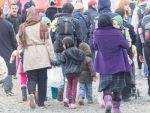
European migrant crisis (2015 - Sector) The European migrant crisis,or the European refugee crisis, is a term given to a period beginning in 2015 when rising numbers of people arrived in the European Union (EU), travelling across the Mediterranean Sea or overland through Southeast Europe.
The term "immigrant" is used by the European Commission to describe a person from a non-EU country establishing his or her usual residence in the territory of an EU country for a period that is, or is expected to be, at least twelve months. Most of the migrants came from Muslim-majority countries in regions south and east of Europe, including the Greater Middle East and Africa.[15][16][17] By religious affiliation, the majority of entrants were Muslim (usually Sunni Muslim), with a small component of non-Muslim minorities (including Yazidis, Assyrians and Mandeans). According to the United Nations High Commissioner for Refugees, the top three nationalities of entrants of the over one million Mediterranean Sea arrivals between January 2015 and March 2016 were Syrian (46.7%), Afghan (20.9%) and Iraqi (9.4%).
Germany has been the most sought-after final destination in the EU migrant and refugee crisis. Thousands of migrants continued to pour into Germany from Austria as of 6 September 2015. Germany's asylum practice is to be based on article 16a of her Basic Law. After the development of the migrant crisis Germany decided to use the derogation possibility of article 17 of the Dublin III Regulation for humanitarian reasons. According to The Wall Street Journal, this "unilateral" open-arms policy triggered both a domestic and an international backlash. However, Germany immediately began to deploy a quota system to distribute asylum seekers among all German states. In September 2015 the federal states, responsible for accommodation, reached the brink of their capacities and criticised the Government in Berlin for its "inconsiderate" approach to the crisis.