Romania's Orphans: Difference between revisions
Jump to navigation
Jump to search
No edit summary |
No edit summary |
||
| Line 1: | Line 1: | ||
[[File:romania-orphanage-1990.jpg|left|150px|link=Romania's Orphans|Image]] | [[File:romania-orphanage-1990.jpg|left|150px|link=Romania's Orphans|Image]] | ||
'''[[Romania's Orphans]]''' <small>(1 December 1990, [[template:Romania|Romania]] | '''[[Romania's Orphans]]''' <small>(1 December 1990, [[template:Romania|Romania]])</small> Shortly after Nicolar Ceauscu was overthrown on December 22, 1989, the world was exposed for the first time to the shocking images of Romania's orphans, especially its handicapped children and babies with AIDS. These children, numbering over 100,000, live for the most part in Dickensian institutions - bleak, understaffed orphanages built by the Ceausescu government to deal with the consequences of its policy of coercively raising the birth rate. The orphans are the grisly legacy of an oppressive regime in a country that lacks both democratic traditions and independent associations of professionals. | ||
[[Category:WHAT]] | [[Category:WHAT]] | ||
Revision as of 12:26, 19 January 2020
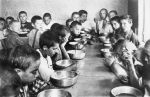
Romania's Orphans (1 December 1990, Romania) Shortly after Nicolar Ceauscu was overthrown on December 22, 1989, the world was exposed for the first time to the shocking images of Romania's orphans, especially its handicapped children and babies with AIDS. These children, numbering over 100,000, live for the most part in Dickensian institutions - bleak, understaffed orphanages built by the Ceausescu government to deal with the consequences of its policy of coercively raising the birth rate. The orphans are the grisly legacy of an oppressive regime in a country that lacks both democratic traditions and independent associations of professionals.